Beer Rating System

Our beer rating system and rating scale is based on overall feel for the beer and the necessity or lack thereof, to have another one of the beers in hand. The scale should be similar to other rating scales that you have seen and used. This scale should be pliable to the point in which you might insinuate your own descriptions for the values — after all, the site is about your personality and subjective views of the beer. So the 10 point scale was born.

The 10 point scale runs from 1 to 10, with 1 being the lowest rating and 10 being the highest. Every review breaks down scores across five sensory categories: Look (L), Aroma (A), Taste (T), Mouthfeel (M), and Overall Impression (O).

The 10-Point Craft Beer Rating Scale

9–10

Superior / Perfect

World-class examples of their style. Flawless execution, complex aromatic layers, exceptional mouthfeel balance, and zero technical defects. A 10 is reserved for brews that redefine a style after multiple tastings.

8

Excellent

A well-crafted, highly enjoyable beer with strong flavor complexity and style accuracy. Minor variation among tasters is acceptable — the beer still needs to be really good with no discernible flaws.

7–6

Above Average / Slightly Above Average

Solid beers you would drink again. Good balance and professional brewing effort, though less agreement among tasters or slight deviation from ideal style characteristics may exist.

5

Average

Nothing technically wrong, but nothing stands out. Drinkable in the right scenario with no memorable malt profile, hop aromatics, or head retention to distinguish it.

4–1

Below Average through Yuck

Beers with off-flavors, poor balance, or technical defects. Two Beer Dudes rarely publish reviews below 5 — we prefer to re-taste on another day before assigning a low score.

Remember when you write a beer review, more than likely, you are taking your first taste of a beer, possibly only, and that there is a lot that factors into the reason you felt the way you did when you wrote a review. Some factors: mood, feelings, like or dislike of beer style, food, other beers drank before, etc. These are the reasons that Two Beer Dudes will more than likely never put a review on the site below a 5. We will try and give the beer another chance on another day.

One last thing: when tasting beer only have about 2 to 3 ounces and drink beers of the same beer style. Split a 12 ounce bottle between friends, formulate your own opinion and then share with each other. Each of you may have found something different within the confines of the glass container. Really try to enjoy the beer for the style that it is and appreciate the effort that the brewer put into making the beer. Trying to be unbiased will give the best overall chance and rating for a beer. Enjoy!

How We Evaluate: The Five Pillars of Beer Judging

To keep our craft beer reviews completely transparent and objective, every single beer we taste is broken down across five core sensory categories. We don't just say a beer is "good" or "bad" — we analyze how well the liquid aligns with historical style profiles, brewing chemistry, and sensory execution.

1. Appearance — Look (L) & Head Retention

The evaluation begins the moment the beer hits the glass. We analyze the liquid's color depth using the Standard Reference Method (SRM) scale, checking for appropriate clarity or intentional haze.

What we look for: We evaluate the foam formation (the head) upon pouring, noting its color, density (creamy, rocky, or wispy), and head retention — how long it lasts.

The Details: As the glass empties, we look for Belgian lacing, the pattern of foam left sticking to the sides of the glass, which indicates a clean glassware surface and high-quality protein structures from the grain bill.

2. Aroma (A) — Volatile Compounds & Hop Aromatics

Up to 80% of what we perceive as flavor actually comes from our sense of smell. Before taking a sip, we gently swirl the glass to release volatile aromatic compounds.

What we look for: We isolate the malt profile (scents of toasted bread, caramel, coffee, or biscuit) and the hop aromatics (ranging from citrusy, floral, and piney American varieties to earthy, spicy noble European strains).

The Details: We also look for yeast-driven byproducts like fruity esters (banana, pear) or spicy phenols (cloves, black pepper), ensuring no off-flavors like oxidation or diacetyl (butterscotch) are present.

3. Taste (T) — Flavor Balance & Style Accuracy

The first sip allows us to confirm what the aroma promised while discovering the deeper structural balance of the beer. Taste hits different zones of the tongue, revealing the interplay between sweet, bitter, and sour profiles.

What we look for: We check how the sweetness of the unfermented malt sugars balances against the bittering alpha acids of the boiling hops.

The Details: The flavor profile must match expectations for the specific style guidelines. For instance, an American Pale Ale should highlight crisp hop bitterness, whereas a traditional German Märzen should lead with rich, clean, bready malt sweetness.

4. Mouthfeel (M) — Body, Carbonation, & Texture

Mouthfeel describes the physical sensations the beer produces inside the mouth, which is entirely distinct from flavor but just as vital to the overall drinking experience.

What we look for: We judge the beer's body (ranging from light and watery to thick and velvety/chewy), its carbonation level (effervescent, spritzy, sharp, or soft), and its overall texture.

The Details: We pay close attention to attributes like astringency (a puckering dryness caused by grain husks), warmth (the noticeable presence of alcohol/ABV in high-gravity beers), and how cleanly the liquid coats or finishes on the palate.

5. Overall Impression (O) — Harmony & Flawless Execution

This final category is where everything comes together. Overall impression isn't just a personal preference rating; it measures the complete harmony, drinkability, and technical execution of the brew.

What we look for: Did all four previous pillars work together seamlessly? Is this beer a flawless representation of its intended style? Does it push the boundaries of craftsmanship successfully, or does it fall flat due to balance or fermentation defects?

The Details: This category ensures that complex beers are rewarded for balance, and simple styles (like a flawless German Pilsner) are celebrated for their clean, crisp perfection.
Frequently Asked Questions

How does the Two Beer Dudes rating system work?

Our rating system evaluates craft beer on a 1–10 scale across five core criteria: Look (L), Aroma (A), Taste (T), Mouthfeel (M), and Overall Impression (O). Each category is scored individually to produce an objective, transparent final rating.

What is considered a good beer rating?

On our 1–10 scale, any beer scoring 8 or above is an excellent, well-crafted representation of its style. Scores of 9 or above indicate superior beer, while a 10 is reserved for world-class brews that redefine their style after multiple tastings.

What do the A, T, L, M, O scores on reviews mean?

These abbreviations map to our five evaluation pillars: L (Look/Appearance), A (Aroma), T (Taste), M (Mouthfeel), and O (Overall Impression). Each sub-score reflects how the beer performed in that specific sensory category.

How does standard deviation measure review consistency?

Standard deviation shows how closely our reviewers agree on a beer's score. A lower standard deviation (closer to 0 on our 1–10 scale) means ratings are tightly clustered — strong consensus. A higher value indicates more spread among individual reviews.

Understanding Review Consistency & Standard Deviation

Standard Deviation is a mathematical (statistics) calculation for determining the clustering (spread) of a group of numbers. Simply it calculates the dispersion of values in a set of numbers. The lower or closer the standard deviation is to 0 the greater the standardization in the numbers (inverse relationship), meaning that the variance in the set of numbers is minimal, the numbers are clustered closely together. Contrarily, the larger the standard deviation, the less the standardization in the numbers, meaning that the variance in the set of numbers is not clustered closely together. That all said, based on the type of numbers being compared a standard deviation of 100, 500 or more might be determined to be low. But, in the case of beer and establishment reviews on this site, a standard deviation should be less than 1.

Standard Deviation Calculation

There are three steps to finding the standard deviation. Calculate the:

  • Mean (average)
  • Variance
  • Standard Deviation

Example set of ratings: [8.36, 9.61, 9.12, 9.08, 9.27, 8.98, 7.91, 9.54].

Mean

(8.36 + 9.61 + 9.12 + 9.08 + 9.27 + 8.98 + 7.91 + 9.54) / 8 = 71.87 / 8 = 8.98

Variance ()

Definition
Take the average of the squared differences from the mean.
  • Take the difference between each rating and the mean.
  • Square the difference (this will always result in a positive number).
  • Calculate the average of the squared differences.
((8.98 - 8.36)² + (8.98 - 9.61)² + (8.98 - 9.12)² + (8.98 - 9.08)² + (8.98 - 9.27)² + (8.98 - 8.98)² + (8.98 - 7.91)² + (8.98 - 9.54)²) / 8
(0.62)² + (-0.63)² + (-0.14)² + (-0.10)² + (-0.29)² + (0)² + (1.07)² + (-0.56)² / 8
(0.3844 + 0.3969 + 0.0196 + 0.01 + 0.0841 + 0 + 1.1449 + 0.3136) / 8 = 2.6475 / 8 = 0.3309375

Standard Deviation (s)

Definition
Take the square root of the variance.
√0.3309375 ≈ 0.575

or as percent of average: ~6.41%

A standard deviation, for this group of numbers and example, less than 1 would signify that the group of numbers is closely related. This may be further verified by determining the range of one standard deviation.

One Standard Deviation

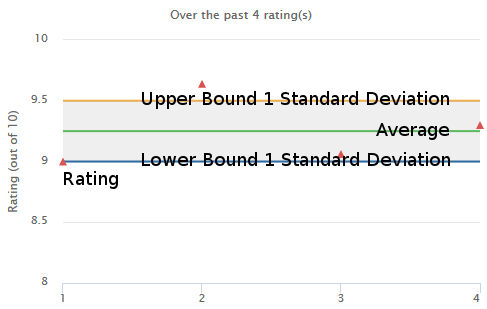
One standard deviation are the numbers that create a range +/- average.

  • 8.98 + 0.575 and 8.98 − 0.575.
  • 9.56 to 8.41

This is what is displayed in the graph on the rating pages.

Standard deviation example graph showing rating distribution

One Standard Deviation Caveats

  1. The lower bound cannot be less than 1.0.
  2. The upper bound cannot be greater than 10.0.
  3. The upper and lower bounds represent the rating scale on the site.
  4. Standard deviation functionality is only applied when at least two ratings have been done on a craft beer or place.

Highest Rated Beers

See how our rating scale applies to real craft beer reviews. Browse all reviews or explore styles we judge against .